
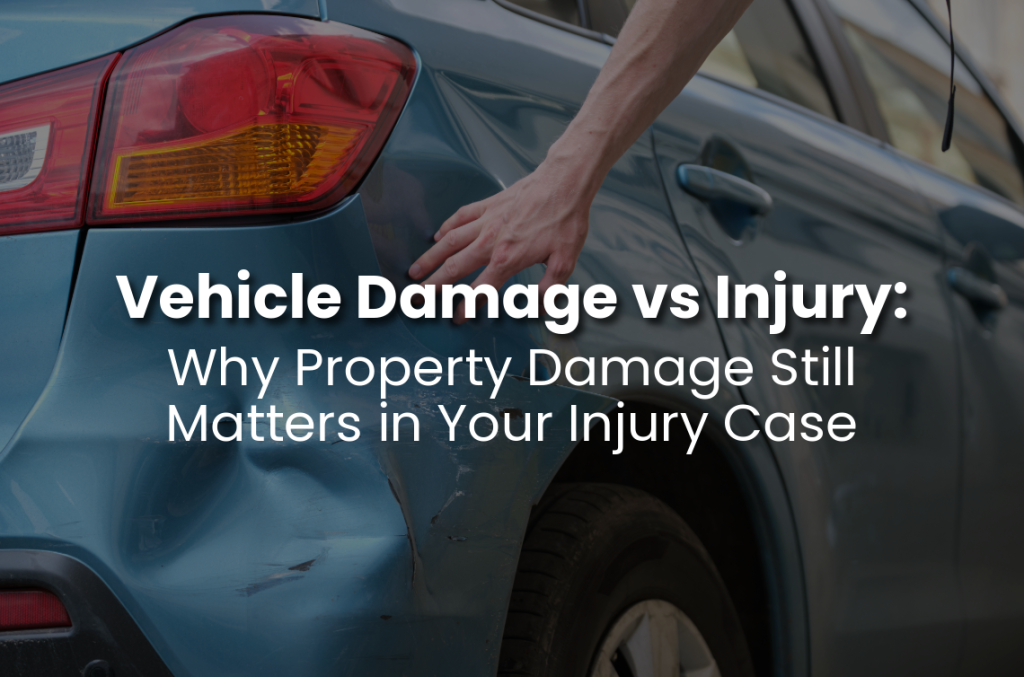
Most people assume vehicle damage and personal injury should move together: a badly damaged car means a badly injured driver, and a small repair bill means a small injury. In practice, the relationship is not that simple.
Say you were stopped on the 210 near Rancho Cucamonga when another driver hit you from behind. The rear bumper took visible damage, but the car still drove, and the photograph you took at the scene looks fairly ordinary.
Weeks later, your neck and shoulder are still being treated, yet the insurance adjuster keeps coming back to two things: the photographs and the repair estimate.
You start wondering why a claim about your body keeps turning into a conversation about a bumper. The answer is that the car is evidence too.
A repair estimate is evidence about the vehicle, but it is not a diagnosis of the person sitting inside it. That does not make it irrelevant.
Property damage can help document what happened to the vehicle, where contact occurred, what repairs were identified, and sometimes whether an account of the collision fits the other physical evidence. Medical records answer a different set of questions about symptoms, examinations, treatment, restrictions, and recovery.
In short, the car tells part of the story, and the medical record tells another part. A well- supported injury claim needs the full picture.
Property damage is part of the crash evidence, not the whole injury claim
When people hear “property damage,” they often think of one number: how much the insurance company says the vehicle will cost to repair.
The actual vehicle record can be much broader than that.
Scene and vehicle photographs: Pictures taken after a crash may preserve areas of contact, visible vehicle damage, roadway conditions, debris, vehicle positions, or other details that become harder to document later. Close-up and wider photographs can also show how the vehicle looked before repairs began.
Repair estimates: An estimate is more than a price tag. Depending on how detailed it is, it may identify the areas inspected, components listed for repair or replacement, and where damage was documented.
But the word “estimate” matters.
California’s Bureau of Automotive Repair distinguishes an initial repair estimate from the final invoice. When additional repairs are identified after work begins, those repairs may need to be separately documented and authorized. After the work is completed, the final invoice records the repairs and parts actually supplied.
That means the first estimate and the final repair record may not always tell the same story.
Maybe the first estimate identifies a bumper cover and paint work. Additional parts may be identified after the vehicle is taken apart. In another case, the original estimate may remain unchanged.
Neither result proves anything by itself about the severity of an occupant’s injury.
Supplemental and final repair records: When additional work is identified, later repair documents can help show how the repair scope changed. A final invoice may provide a more complete record of what was repaired or replaced than the initial estimate. This is important, because an insurance discussion that focuses only on the first dollar figure may leave out later information about the vehicle.
However, it still does not turn a repair technician into an accident reconstruction expert or a repair invoice into medical evidence.
Total-loss documentation: A vehicle can be declared a total loss when repairing it no longer makes economic sense compared with its value. That is fundamentally a property valuation decision.
A total-loss vehicle does not automatically prove a severe bodily injury, nor does a drivable vehicle automatically prove there was no significant injury.
The vehicle and the person require separate evaluations.
Prior-damage information: If the insurer argues that some visible damage existed before the current collision, earlier photographs, repair records, or other documentation may become relevant. Context can help separate what was already there from what was documented after the new crash.
The terminology can also be confusing.
Property damage refers to damage to the vehicle or other property.
Damages in a personal injury case refers to losses for which compensation may be sought, including medical expenses, lost income, future losses where supported, and non-economic harm such as pain and disruption to everyday life.
The repair cost is not a measurement of those injury damages, but it can become part of the insurer’s argument about how the injury claim should be evaluated.
The vehicle record helps explain the crash, and the medical record helps explain the injury.
Photos and repair estimates shape how insurers evaluate the claim
Vehicle photographs are persuasive for a practical reason: they are immediate.
An adjuster can open a claim file and look at a picture of a crushed front end or a lightly damaged bumper in seconds. A repair estimate can reduce the property claim to a number that is easy to understand.
Those pieces of evidence tend to shape early conversation. Still, the adjuster has to decide whether the claimed injuries and damages are adequately supported, and vehicle photographs and repair figures give the insurer something concrete to compare with the injury claim.
An adjuster may therefore argue that the visible damage was limited, so the claimed injuries and treatment appear disproportionate to the crash.
It is not unreasonable to ask the question, but the argument is incomplete.
Photographs need context.
A picture of the rear bumper may show visible exterior damage. It may not show every component later identified during the repair. Without additional information, it may not distinguish older damage from damage caused by the current crash. And a photograph captures one moment, not necessarily the entire sequence of a complicated collision.
Most importantly, it does not establish the medical condition of the person inside the vehicle.
None of that makes photographs unreliable; it makes them partial.
The photograph matters, but what it proves is the harder question.
The same caution applies when people ask about car damage and an injury settlement, because there is no simple formula that converts a repair bill into an injury value.
A $2,000 repair estimate does not create a $2,000 injury, and a $20,000 repair bill does not automatically establish a serious bodily injury claim.
Settlement value can depend on medical evidence, documented losses, fault, insurance coverage, long-term effects, and other facts specific to the claim. Repair cost may shape how an adjuster perceives the collision, but it is not the measure of the injury.
This is where the related question of whether limited vehicle damage means limited injury becomes important.
That medical question deserves its own discussion. Here, the focus is on why vehicle damage still matters even though it does not diagnose the person.
The answer is that it remains part of the evidence used to understand what happened.
The useful question is what the vehicle evidence shows
“Big damage or small damage” is usually too simple a frame. A better question is what the specific evidence actually documents.
Federal crash investigators use the same basic principle. NHTSA crash investigations draw from multiple sources, including the scene, vehicle inspections and measurements, photographs, interviews, police information, and medical information about injured occupants.
A personal injury case is not a federal crash investigation, but the principle is useful: no single piece of evidence must answer every question.
Impact location: Vehicle damage may help show where contact occurred. Damage to the rear of one vehicle and the front of another may support parts of an account of a rear-end collision, while damage along the side of a vehicle raises different questions. The damage does not automatically reconstruct the crash, but it does provide context.
Repair documentation: Instead of looking only at the dollar figure, the repair records may show which components were inspected, repaired, or replaced. The initial estimate can also be compared with supplemental work and the final repair invoice where those records exist.
Again, the repair record describes repairs; it does not independently describe what happened to the occupant.
Prior damage: If the insurance company argues that a damaged area existed before the crash, previous photographs or repair records may help answer that question with evidence rather than assumption.
Liability: Liability simply means legal responsibility for what happened.
Depending on the circumstances, vehicle damage may help an insurer, attorney, investigator, or qualified expert evaluate whether someone’s version of the crash fits the physical record.
Picture a side-impact collision on Foothill Boulevard where the two drivers give different accounts. The damage alone may not settle the dispute, but the location of contact on each vehicle may become relevant when it is considered alongside witness statements, video, the police report, and other available evidence.
A rear-end collision, sideswipe, intersection crash, and multi-vehicle collision each raise different questions.
Vehicle photographs can contribute to the liability analysis, but they do not automatically determine fault.
Fault carries real weight in California, where comparative fault rules can reduce an injured person’s recovery when that person is assigned part of the responsibility for the crash.
Electronic vehicle data: Some vehicles have Event Data Recorders, commonly called EDRs or black boxes, that may preserve technical information surrounding a crash.
NHTSA has described EDR information as a potentially useful crash-investigation tool while also emphasizing that the information has limitations and should be considered alongside other evidence.
That same principle applies throughout the vehicle-damage discussion: one photograph, one estimate, or one electronic record may be useful, but none must tell the entire story by itself.
A strong injury claim puts the vehicle evidence beside the medical evidence
Here is the part of the record the car cannot supply. Property evidence cannot establish what symptoms you reported, document what a healthcare provider found during an examination, or show what diagnosis was made, what treatment was recommended, whether work restrictions were issued, how recovery progressed, or whether future care may be needed.
Those are questions for the medical record, and the medical record is not automatically conclusive either. It still has to be evaluated alongside the crash, treatment history, prior conditions, and other evidence.
Different pieces of evidence answer different questions, and a strong claim puts them together.
Vehicle documentation: Photographs, repair estimates, supplemental estimates, final invoices, tow records, total-loss documentation where relevant, and other records can preserve what happened to the vehicle.
Medical chronology: Medical records can document what symptoms were reported and when, what providers found, when treatment began, what care was recommended, whether restrictions were issued, and how the condition changed over time.
A bumper photograph cannot answer those questions, because the medical record has its own job.
Work impact: When an injury affects someone’s employment, physician restrictions, missed shifts, wage records, and employer documentation may help establish what the crash changed professionally.
That evidence becomes especially important when the claim includes lost wages or loss of earning capacity.
Crash evidence: Police reports, witness statements, photographs, surveillance or dash-camera video where available, and EDR information where relevant may help establish how the collision happened.
Prior history: Previous injuries may matter to the medical portion of the claim, and previous vehicle damage may matter to the property portion. The existence of earlier history does not automatically decide the current dispute; it creates another question the evidence may need to answer.
More paperwork is not automatically better. A stack of unrelated documents does not strengthen a claim simply because it is large. The goal is consistent, relevant documentation that helps explain the full picture.
That is also where the vehicle evidence finds its place in a personal injury demand.
A strong personal injury demand package does not simply state a settlement number. It brings the liability evidence and damages evidence together into one organized argument.
The sequence is straightforward: what happened, what the vehicles show, what the medical records show, what the injury changed, and what losses are documented.
The property evidence is neither hidden nor overstated; it is one part of the claim, placed where it belongs.
Timing matters too. A complete repair record may clarify the property side of the collision while the medical side is still developing.
If the medical picture has not stabilized, there may still be unanswered questions about future treatment, work limitations, or long-term effects. That is why maximum medical improvement and settling too early can matter before a settlement release is signed.
The goal is not to collect every document that exists but to build a record in which the relevant pieces fit together.
The car matters, but it does not get the final word on your injury
The vehicle, the medical records, and the circumstances of the crash are all evidence, and the effect on your work and everyday life can be evidence too.
The important part is understanding what each one establishes.
A repair estimate can document proposed vehicle repairs, a supplemental estimate can document additional work identified later, and a final invoice can show what repairs were performed.
A photograph can preserve visible vehicle damage, and vehicle evidence can contribute to a fault dispute.
Medical records can document symptoms, findings, treatment, and recovery, while work records can document restrictions and income loss.
None of those records becomes stronger by pretending the others do not exist. That is especially important when an insurer is focusing heavily on the condition of the vehicle.
The answer is not to say that property damage is irrelevant because the claim involves physical injury. The car was part of the crash, and it deserves to be documented accurately.
Before settlement, a repair estimate should not set the value of an injury claim by itself, and neither should an incomplete medical picture.
At Muhareb Law Group, we help injured people in Rancho Cucamonga, Ontario, Fontana, Upland, San Bernardino, and throughout the Inland Empire understand how collision evidence, medical documentation, and other records fit together in a personal injury claim.
Contact Muhareb Law Group for a free consultation. Call (909) 519-5832 or reach out online.
Let us help you build the full picture before anything gets signed.
FAQs
Does property damage affect a personal injury claim in California?
Yes. Property damage can affect how a personal injury claim in California is evaluated because vehicle photographs, repair records, impact locations, and other evidence may help explain the crash. Property damage does not diagnose an injury, however. Medical records, treatment history, work restrictions, and documentation of how the injury affected daily life answer separate questions. A well-supported claim puts both types of evidence together.
Does more car damage mean a bigger injury settlement?
No. More car damage does not automatically mean a larger injury settlement because there is no formula that converts repair cost into injury value. Settlement value can depend on medical evidence, documented expenses, lost income, fault, long-term effects, insurance coverage, and other facts. Severe vehicle damage may influence how an insurer views the collision, but the repair bill alone does not determine the value of bodily injury damages.
Can I have an injury claim in California if my car had minor damage?
Yes. Limited vehicle damage does not automatically prevent someone from pursuing an injury claim in California. The insurer may consider minor property damage when evaluating whether the reported injuries appear consistent with the collision, but the repair estimate is only one part of the evidence. Medical records, examination findings, treatment history, crash evidence, and relevant prior medical history help answer the separate question of whether an injury occurred.
Why does the insurance company want photos of my damaged car?
Vehicle photographs can document visible damage, areas of contact, the condition of the vehicles, and other facts relevant to how the collision occurred. They may also help an insurer evaluate property damage and questions about fault. Adjusters sometimes compare the apparent vehicle damage with the injuries being claimed. The photographs are legitimate evidence, but they need context from repair records, medical documentation, and the rest of the crash evidence.
Should I keep my repair estimate after a car accident?
Generally, yes. Keeping the initial repair estimate, supplemental repair records, final invoice, and your own photographs can preserve an important part of the crash record. The first estimate may not always reflect every repair ultimately performed, which is why later documentation can matter. These records do not determine whether you were injured, but they can help document what was inspected, repaired, or replaced if the vehicle damage later becomes disputed.